Shoreline / WA

Cloth Wiring and Ungrounded Circuit Replacement in Shoreline, WA

Shoreline Knob and Tube replaces cloth-covered and ungrounded wiring in Shoreline homes from the 1940s and 1950s, the decades that built much of the city’s older housing. This wiring is not knob and tube: it is sheathed cable, with both conductors bundled inside a cotton-braid jacket, but most of it was made without a ground wire. We sort out which circuits can stay with added protection and which should be replaced with new grounded cable.

The same postwar cable runs through thousands of 1950s and early-1960s houses in Lake Forest Park and Edmonds, and we take on those homes as well as Shoreline ones.

Request a quote
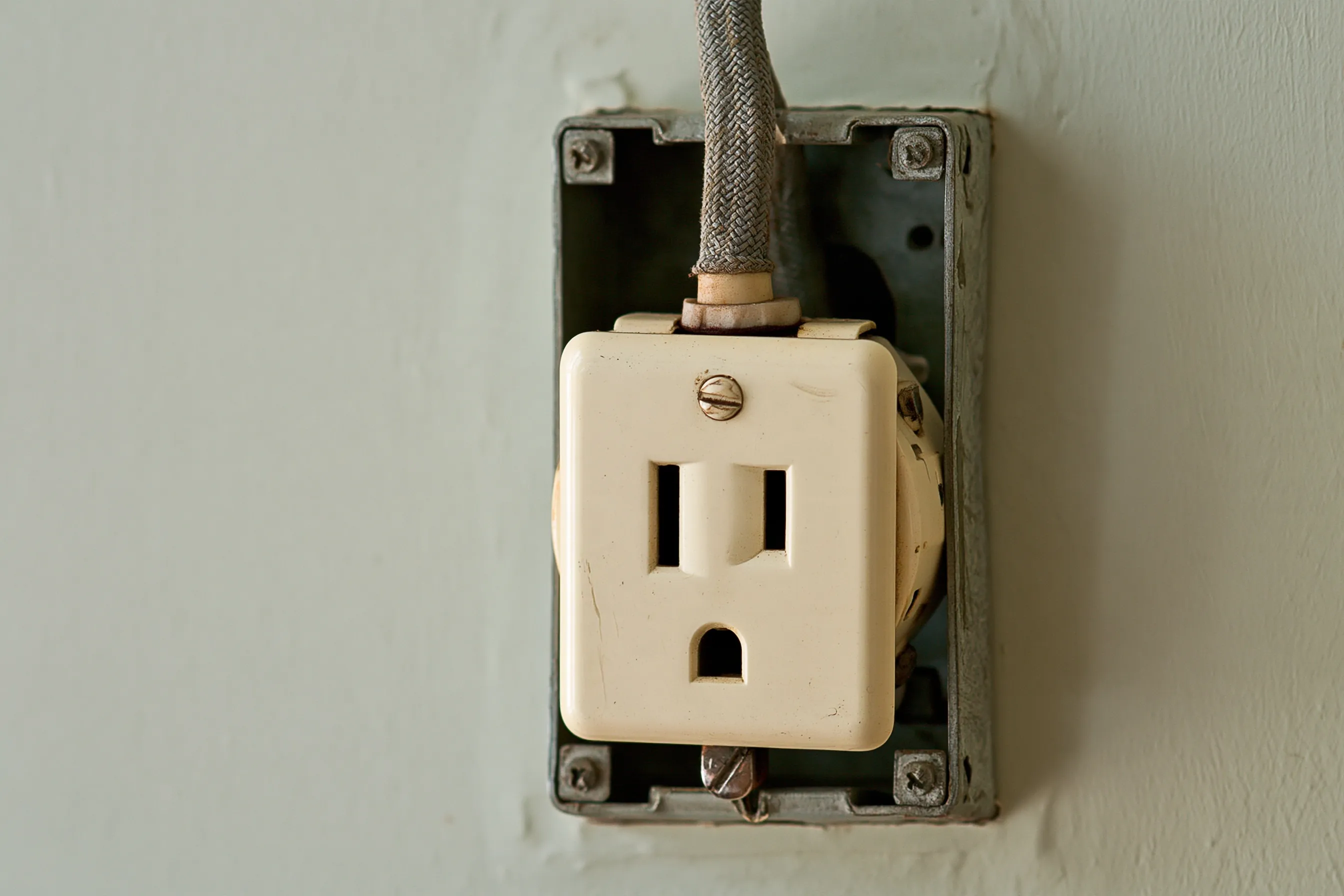
Old outlet pulled forward from a metal box in a plaster wall, with aged cloth-covered cable entering the box

Older wiring found in 1940s and 1950s homes

Cloth-braided cable without a ground wire

Early nonmetallic sheathed cable wrapped its conductors in cotton braid inside a fabric outer jacket. Until the early 1960s most cable of this kind sold for houses had no grounding conductor; the national code began requiring an equipment ground on all branch circuits in 1962, and plastic insulation replaced the braid over that decade. Seventy-odd years on, condition depends on heat, splices and how often the cable has been disturbed, so we look at the runs and connections instead of judging by age alone.

Two-prong outlets on ungrounded circuits

Two-slot receptacles are the most visible sign of an ungrounded circuit. Plug adapters with a ground tab, or a three-prong receptacle installed with nothing connected to its ground screw, look grounded without being grounded, and surge strips and electronics that depend on a ground get none. The real choices are labeled GFCI protection or a new grounded circuit, and which one fits depends on what the outlet feeds.

Knob and tube spliced into later cable

Houses that were enlarged or partly rewired in the 1940s and 1950s can carry both systems at once: knob and tube in the original rooms, braided cable in an addition, and splices where one feeds the other, often in the attic or crawlspace. Those transitions are easy to miss on a quick look. We map them during the survey so the scope covers every circuit still relying on the older wiring.

Replace the circuit or protect the outlet?

GFCI protection where no ground exists

When no ground is available, the electrical code allows a two-prong receptacle to be replaced by a GFCI receptacle, or by a three-prong receptacle fed through a GFCI upstream. Each must be marked “No Equipment Ground”, and outlets protected from upstream also carry a “GFCI Protected” label. A GFCI trips on ground faults and protects people from shock, but it does not create a ground, so surge protectors and equipment that rely on one gain nothing. The rules applied are those of the code edition in force when the permit is issued, and Washington adopts a new edition at the end of 2026.

New grounded circuits for kitchens, baths and heavy loads

New cable makes more sense where loads are heavy or grounding matters: kitchen counters, bathrooms, laundry, a home office, or any circuit whose old cable shows damage. A new run from the panel gives a true equipment ground and lets circuits be laid out for how the room is used now. The quote shows outlet by outlet which ones get new wiring and which get protection only.

Permits and inspection in Shoreline

Replacing circuits generally needs an electrical permit, and in Shoreline that permit comes from Washington L&I rather than the city. The contractor doing the work buys it before starting. New cable is inspected before walls or ceilings are closed, so any patching is scheduled after that visit, and the permit later shows in L&I’s public lookup for the address if you sell.

Frequently asked questions

Does cloth wiring always need to be replaced?

No single rule says it must be. Braided cable that is intact, undisturbed and not overloaded can sometimes remain, with GFCI protection where the outlets need it. Brittle or cracked insulation, heat damage, amateur splices or plans for heavy new loads all point toward replacement. An electrician who opens boxes and inspects the accessible runs can tell you which circuits fall into which group.

Is cloth wiring the same as knob and tube?

No. Knob and tube runs two separate wires, each held on porcelain knobs and passed through framing in porcelain tubes. Cloth-covered cable bundles the conductors in one fabric jacket and is fastened to framing much like modern cable. Both usually lack a ground, and the two can share a house when later cable was added to an older system.

Can I just install three-prong outlets?

Only if there is a ground path for them, or if they are GFCI-protected and labeled “No Equipment Ground”. A three-prong outlet on an ungrounded circuit without that protection is misleading, because anything plugged into it assumes a ground that isn’t there. An electrician can check whether a ground is available and which option suits each circuit.

Where the new cable has to pass through lath and plaster, the plaster wall rewiring page shows how routes and openings are planned. The Shoreline Knob and Tube homepage sets out how braided cable fits alongside the city’s knob and tube.

Your next step

Discuss cloth wiring and ungrounded circuit replacement

Mention the decade the house dates from, which rooms still have two-slot outlets, and any rooms you plan to remodel soon, so we know where to start. If you have spotted fabric-jacketed cable at the panel or in the crawlspace, say so. We'll get back to you soon with an estimate or any questions we have. Estimates are free and there's no obligation.

Call (425) 725-5719

Call (425) 725-5719